In September last year I bought a pair of AirPods Pro. Messing around with them, I did an in-app hearing test for the first time in my life. Turns out I had better than average hearing.
A week later I thought my left AirPod was faulty. I have a habit of listening to podcasts going to sleep, and I couldn't hear voices properly through it. It sounded like a blown speaker. I went through the troubleshooting steps and worked out that the problem wasn't the speaker. It was my ear.
If this is happening to you right now, stop reading and get help today.
Sudden sensorineural hearing loss is a medical emergency. It is treated with oral steroids, and the treatment window is short. Guidance points to starting within days, and the window is generally considered to close at around two weeks. If you have lost hearing suddenly in one ear, go to a GP, an emergency department or an ENT service now. Do not wait for a routine appointment.
I lost about two weeks to the obvious suspects. First earwax, which I was fairly convinced of because I had that blocked, hollow, whooshing sound you get when a canal is fully occluded. Then Eustachian tube dysfunction. Two weeks in I finally got to an audiologist, who told me I had lost around 30% of my hearing in that ear and that it was nerve related. Sudden sensorineural hearing loss, or SSNHL.
What I hadn't known, and what almost nobody knows until it happens to them, is that this is treated as a medical emergency. The causes are poorly understood, though one theory is that a virus in the inner ear causes inflammation which affects the nerve. Somewhere between a third and two thirds of people recover some hearing on their own within a couple of weeks, but for the rest it can be permanent, and steroids given early are the only treatment with real support behind them.
Sixteen days after it hit me, having read enough to understand what I was looking at, I turned up at an emergency care clinic and asked for steroids. They confirmed this was how ENT deals with SSNHL and started me on the oral steroid course they prescribe for it.
It worked. I tested my hearing every day and watched the numbers climb back almost to normal.
Then I took a long-haul flight and it dropped again, this time with pressure, tinnitus and diplacusis, which is when the same note arrives at a different pitch in each ear and everything sounds slightly robotic. When your inner ear is doing this to you it is disorienting.
Things settled after that and parked at around 30 dB loss at 250 and 500 Hz. Then at Christmas I noticed I was hearing in different tones again, and my testing showed a sudden 50 dB loss at 1 kHz. That is the frequency we actually talk at. Whatever this was, it was spreading. Back on the steroids, and over a few weeks 1 kHz came all the way back.
That turned out to be the pattern. Worse, better, worse, better. It has since been diagnosed as cochlear hydrops.
Cochlear hydrops is a pressure problem. Endolymphatic fluid builds up in the inner ear. The good news, relatively speaking, is that it is not SSNHL, where the mechanism appears to be damage that often doesn't come back. Hydrops is more mechanical, and hearing can recover. Most people learn their triggers and it stabilises or improves. A minority go on to develop Ménière's disease, where the balance organ gets involved and vertigo attacks start. The numbers here are soft, and I'll come back to why, but published follow-up studies of people with my sort of presentation put it somewhere in the region of 10% to 30%.
Treatment options are limited, though there is movement. Ebselen, an oral drug also known as SPI-1005, completed a Phase 3 trial for Ménière's disease and was given FDA Breakthrough Therapy Designation in December 2025. It is still investigational and not approved, but it is the first thing in a long time to look promising.
So this is not a nothing diagnosis. Is it going to settle, or is it going to progress? And on the bad days, when you wake up with roaring tinnitus and a head full of pressure, you badly want to know whether today is worse than last Tuesday.
I started testing my hearing almost daily.
The line that made sense of all of it
Months later I saw an ENT consultant. We went through the fluctuations, the symptoms, the various tests, and she made an offhand remark.
An audiogram is just a snapshot.
She wasn't talking about anything I was building. She was making a clinical point about how hard it is to assess fluctuating hearing from a test taken at one particular moment. But it named the exact problem I had been circling for months.
A clinical audiogram can be an extremely accurate snapshot. It is still a snapshot. If I test well on Monday, that is a true record of Monday. If I test badly three months later, that is a true record of that day. Both are correct. Neither tells you what happened in between. Did it slide gradually or drop overnight? Did it fluctuate twenty times? Did one frequency go before the others? Did it recover after a medication change?
For a stable hearing loss those questions might not matter much. For a condition where hearing moves 20 or 30 dB and back again, they are not details. They are the condition.
But can you trust a hearing test done at home?
Fair question. There isn't much point building a longitudinal record if the measurements underneath it are junk.
Apple describes its Hearing Test as a validated pure-tone hearing test, built on the Apple Hearing Study and checked against clinical pure-tone audiometry. It is a regulated health feature and needs regulatory authorisation in each market where it is offered. Two things make or break a test done outside a booth: background noise, and how the tips sit in your ear. It checks both before it will run.
It also has limits worth being honest about. It is air conduction only across a limited set of frequencies. It cannot produce an air-bone gap, so it cannot tell you whether a loss is sensorineural or conductive. It is not a substitute for an audiologist and I have never treated it as one.
Apple's test is not the only way in. EbbChart has its own in-app hearing test that runs on AirPods or ordinary headphones, which matters if you don't have AirPods Pro, or you live somewhere the Apple feature has not been authorised yet. Audiograms already sitting in Apple Health import on their own, and clinical results can be entered by hand. The audiograms from the hospital sit on my chart alongside everything else. The point was never which instrument you use. It is that the same ear gets measured the same way, often enough for a pattern to appear.
What I could do was check it against my own clinical results.
On 23 July I had my hearing tested professionally.
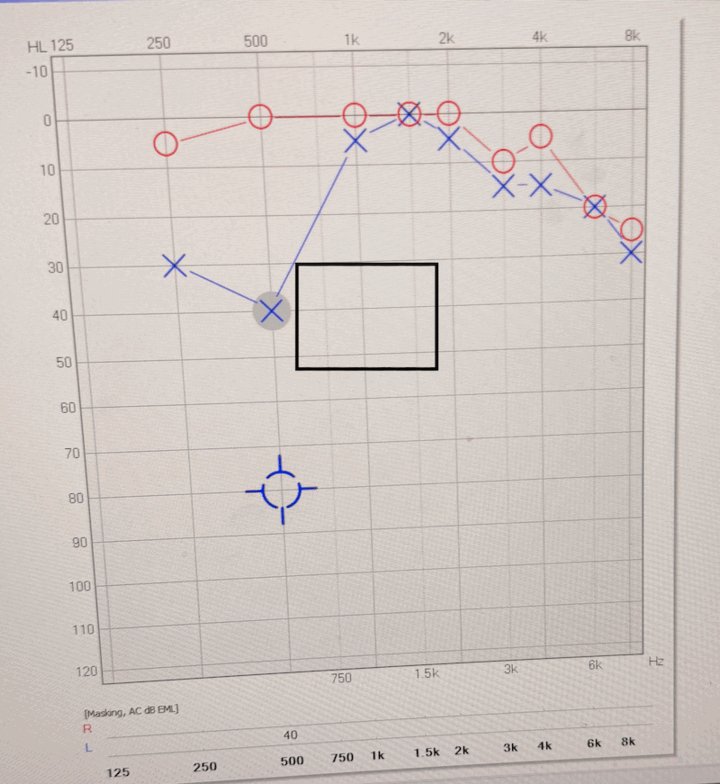
The pattern in my left ear is obvious. Low frequencies down, recovering to near normal by 1 kHz.
I did the Apple test the same day.
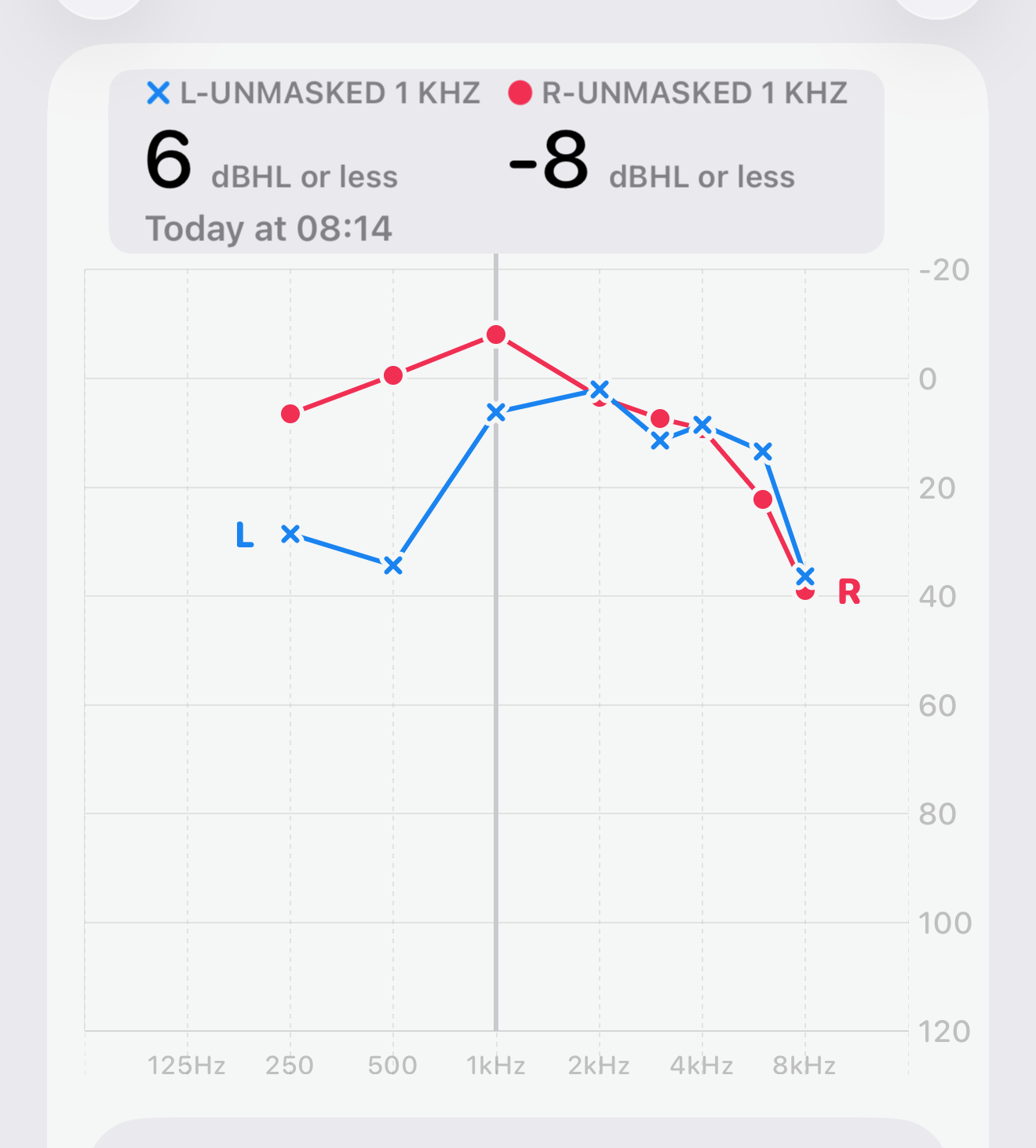
Putting the important frequencies side by side, left ear:
| Frequency | Clinical audiogram | Apple Hearing Test | Difference |
|---|---|---|---|
| 250 Hz | 30 dB | 29 dB | 1 dB |
| 500 Hz | 40 dB | 34 dB | 6 dB |
| 1 kHz | 5 dB | 6 dB | 1 dB |
| 2 kHz | 5 dB | 2 dB | 3 dB |
This is one comparison from one person and I am not pretending it is a validation study. Apple has done that work separately. The two tests do not agree exactly, and the largest gap is at 500 Hz.
The shape is what matters, and the shape is almost identical. The test picks up the low-frequency loss in my left ear and its recovery by 1 kHz. And this hasn't been a one-off. My home tests have repeatedly tracked changes I can actually hear. That was enough to convince me I wasn't collecting hundreds of meaningless numbers.
Accuracy is only half of it
A clinical audiogram is done in a better environment and tells you things a home test can't. If I need to know precisely what is going on, I want an audiologist.
But with a fluctuating condition there is a second dimension, and it is one clinical audiology can't solve for. Frequency of measurement.
I might get a handful of clinical audiograms in a year. I can test at home every day, sometimes twice.
This week is a good example. My hydrops had deteriorated badly. Pressure and tinnitus were overwhelming and my low frequencies were about the worst they had been in months. Then 1 kHz, which had mostly held up, dropped to around 36 dB. That got my attention.
The following morning it was 17 dB. An hour or so later, 6 dB.
Same frequency, same ear, close to normal, then a substantial loss, then back again, inside a day. If my clinical audiogram had landed at the bottom of that dip it would have shown significant loss at 1 kHz. The next morning it would have shown essentially normal hearing. Both correct. Neither the whole story.
What a year of tests looks like
Once you put months of tests beside each other, you stop looking at an audiogram and start looking at a history.
I can see the original loss. Recovery after steroids. The deterioration at Christmas. Frequencies recovering independently of each other. Long stretches where 250 and 500 Hz were down while 1 kHz sat almost normal, and then 1 kHz suddenly moving and sometimes coming straight back.
And I can put other things on the same timeline. When I started steroids and what happened after. When I started betahistine, and what happened when I stopped. When I started a diuretic. When the tinnitus was worst. What happened after flying, after skiing at altitude, after a long run.
At some point I wasn't collecting audiograms any more. I was building a record of the condition.
I have around 260 of them now, covering close to a year. There is a lot in there I simply would not remember. I know Christmas was bad and I know skiing seemed to coincide with a deterioration. Ask me what 500 Hz was doing three days after I started a medication six months ago and I have no idea. The data does.
That is how I think about EbbChart now. It is partly about hearing tests. Mostly it is a memory, and it remembers the boring days as well as the dramatic ones. The boring days turn out to matter.
EbbChart is the bit between the snapshots
That is the shortest explanation I have for why I built it.
It is a place to keep things. A clinical audiogram tells you what your hearing looked like at an important point in time. EbbChart is where I keep everything around it. The hundreds of measurements, the good weeks and the bad ones, the tinnitus and pressure notes, the medication changes, and what I was doing just before things moved. All in one timeline I can scroll through, and export and bring to an appointment.
To be clear about what it is and what it isn't. EbbChart is a personal tracking tool. It is not a medical device and it is not clinically validated. It does compare a new test against your own history and tell you when a reading sits well outside your usual range, because on a bad morning that was the thing I most wanted to know and could least judge for myself. What it will not do is tell you what a change means, why it happened, or what your hearing is going to do next. Those are questions for your audiologist and your ENT, and turning up with a year of organised history makes that conversation better than my memory ever did.
Apple made something significant possible here. A pure-tone test you can do at home in five minutes, one Apple describes as validated against clinical audiometry, changes what is realistic to record at all. But a test result on its own is still a snapshot. What I needed was everything around it: each result on one timeline, with the medications, the symptoms and the bad mornings sitting beside them, in a form I could hand to a consultant. That is the part I had to build.
Why this might matter beyond me
When I went looking for an answer to the obvious question, will this progress, the evidence I found was thin. Small cohorts, often ten or twenty patients, with audiograms taken weeks or months apart.
It is hard not to wonder what the picture would look like with daily records from a hundred people with the same pattern I have, with medications, symptoms and activity on the same timeline. Or a thousand.
That is a large part of why EbbChart is free. Whether any of that data could ever be useful to researchers is a much bigger question, and it comes with a lot of conditions attached. Consent that actually means something, ethics oversight, and an honest view of how identifiable a year of daily health records really is. I am not going to hand-wave that in a closing paragraph, so I want to write about it properly in a follow-up post. For now, your data is yours and it stays on your side of the fence.
Disclosure and disclaimer. I built EbbChart and I have an obvious interest in you finding it useful. Nothing here is medical advice, and none of it should be used to make decisions about your own treatment. It is one patient's account of what happened to him. Hearing loss needs to be assessed by a clinician, and sudden hearing loss needs to be assessed today.
If you are going through something similar, do get in touch at hello@ebbchart.com. I like hearing from other patients and from researchers working in this area.
Sources
- AAO-HNS Clinical Practice Guideline: Sudden Hearing Loss (Update)
- AAO-HNSF Sudden Hearing Loss guideline fact sheet
- Cochlear Meniere's: A Distinct Clinical Entity With Isolated Cochlear Hydrops on High-Resolution MRI?
- Acute low-frequency hearing loss without vertigo: prognostic parameters
- Sound Pharmaceuticals: FDA Breakthrough Therapy Designation for SPI-1005
- Apple: Hearing Test feature for AirPods Pro
- Apple: Hearing health features and validation
- Apple Support: Taking a Hearing Test with AirPods Pro